
Not long ago, we asked you to stop and imagine a world without sharks and rays. A world where the ocean’s balance collapses. We asked you to put your name to a petition to help us prevent this. Today, we are sharing something different with you: a victory. A step closer towards our goal, a glimmer of hope.
We pour our hearts and energy into fighting for the protection of our oceans, and moments like this give meaning to everything this incredibly united community does.
Together, we changed the narrative.
Thanks to thousands of voices joining Padi Aware’s call for action, the petition to strengthen shark and ray protections received enough signatures to reach its goal. That win belongs to every single one of you who took a moment to care, to read, to share, to sign.
This achievement arrived at a crucial moment. Last week, during the 20th meeting of the Conference of the Parties (CoP20) to the Convention on International Trade in Endangered Species (CITES), world delegates discussed protections that will shape the future of countless species. And now, because of you, sharks and rays have been moved to Appendix I, granting them full, strict protection. This involves the prohibition of international commercial trade.
This is bigger than you might imagine…
Here in Mozambique, we are lucky enough to encounter some of the key species that urgently needed this protection: oceanic whitetip sharks, whale sharks, and manta rays. Being able to observe them so closely makes us even more invested in their survival. But we have also witnessed their declines, a reality that strengthens our resolve.
With our fieldwork and research, we contribute to their conservation and protection. Through our Sustainable Fishing Project (SFP), we engage local communities to promote sustainable fishing practices, whilst tackling ocean literacy and many other barriers our community faces to sustainable marine resource use.
Kings of the reef
A reef with sharks is a reef in harmony. Sharks keep food webs balanced, control prey populations, and help coral and seagrass systems stay healthy. Not only are their roles essential for our oceans’ health, but when you get to know them, I can guarantee you will fall in love. The awe they inspire, the way they make you feel so small… They keep the reef’s order, and that’s why we call them the kings.
Oceanic whitetip sharks used to be one of the most common predators of the open ocean. They are bold, curious, and play a major role in pelagic food webs, scavenging, hunting, and helping keep oceanic ecosystems functioning. Tragically, their populations have declined by more than 90% in many places because of targeted fishing and global fin trade.
It is important that we understand the ocean is connected. Healthy shark populations help maintain the balance of species that support fisheries and keep marine ecosystems resilient to stressors like climate change. Losing oceanic whitetip sharks would be another domino in a chain of ecological loss we can’t afford.

Gentle giants
Whale sharks, the ocean’s giants, our gentle giants. They are one of the three known filter-feeding shark species. Despite their “slow swimmers” fame, they manage to travel between 24 and 28 kilometres every day. Whale sharks are responsible for many ecological functions. Through their dynamic feeding and constant movement, whale sharks help circulate nutrients across the ocean. Their vertical and horizontal swimming creates small but meaningful currents that transport nutrients from deep and coastal waters into nutrient-poor tropical seas, supporting the resilience of these ecosystems.
Their immense size also turns them into moving habitats. Remoras, pilot fish, and golden trevallies find protection alongside them, while schools of tuna often collaborate with whale sharks to create dense “bait balls” of small prey that both species share. Even after their passing, whale sharks continue to give back. As their bodies sink to the seafloor, they become rich sources of food and shelter for deep-sea organisms, and sustain marine life for decades through slow decomposition.
Despite doing so much for the ocean, they still are highly endangered. Whale shark populations declined by over 50% in the last 75 years. Long-term research along the Mozambican coast, where Love The Oceans operates, shows that the local whale shark population has fallen by nearly 90% in just over a decade. These results are deeply concerning for what was once one of the world’s largest whale shark aggregations. We have tried to make a difference in the past, and managed to achieve the closure of multiple whale shark fisheries. However, these majestic creatures are still targeted for their meat, fins, and oil, and are often victims of bycatch due to dangerous fishing techniques.

Wise filter-feeders
Just like their shark cousins, rays are also key ocean caretakers… With their graceful and curious character, they shape the seafloor and balance marine life. They are tremendously intelligent, and this makes us wonder whether they know more than what we think they do…
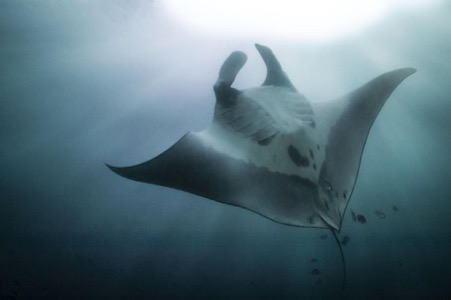
Manta rays have the biggest brain-to-body ratio of all fish species, even bigger than our grandiose whale sharks. Science has shown us that they have highly developed brain areas for learning, problem solving, and communicating. They even have self-awareness. Are they really that different to us?
However, along Love The Oceans’ coastline, sightings of reef mantas have declined over the past 15 years by 82.4%. Threatened by extinction, efforts to protect them were so strong we managed to add manta rays to Appendix II in the 2013 Convention on International Trade in Endangered Species (CITES).
Thank you from Love the Oceans
We hope, from the bottom of my heart, this makes you understand how essential these species are, as well as their maximum protection, to ensure the health of our oceans. We hope this makes you see today how your actions matter, how you can contribute from your home.
This momentous movement to protect these animals demonstrates how collective action by thousands of people who care about the environment can create positive change. It has taught us that when people come together, change happens.
You helped push for stronger global protections.
You helped amplify the voices of species that cannot speak for themselves.
You helped bring hope back into a fight that desperately needs it.
Thank you to every single one of you for trusting and taking action.
—
Words by Laura Ruiz de Azúa
Thank you for taking your time to read this blog by the Love The Oceans team. If you’d like to find out more about our work, you can read about our expeditions here, donate here, or read our impact report here. Thank you for your support.
Contact us: info@lovetheoceans.org