2 Week Expedition March 2026
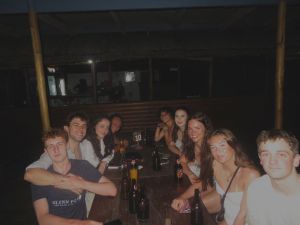
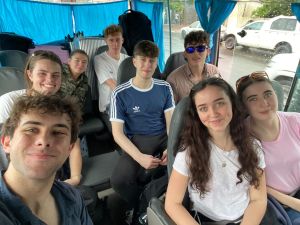
Over this past week, myself and a group of 8 other Research Assistants have been taking part in the first half of the Love the Oceans 2-week expedition in Guinjata, Mozambique, and what a week it’s been! On the weekend we made the drive from Maputo Airport to Jangamo Bay and settled in over the next couple of days at Blue Moon Beach Resort, our home for the next two weeks. We got to know all the other Research Assistants we’d be working with, spent time by the pool and enjoying authentic Mozambican food made for us by the amazing LTO chefs. We got to discover the beautiful Guinjata beach and Jay’s Dive Bar (which will certainly be seeing us again this weekend) and started getting used to the extreme heat. But on Monday the real work would begin…
On Monday, Francesca (LTO’s Managing Director) and Joana (LTO’s Marine Program Coordinator) got us straight into learning all about the incredible wildlife and community structure in the area of Guinjata, as well as teaching us about LTOs projects for the area to support the local ecosystem, the animals, and the humans who rely on them. The key project is creating a marine protected area (MPA) along the coast of the Inhambane province that provides a migratory pathway to humpback whales and is home to whale sharks and manta rays year-round. However, this does not come without their setbacks and roadblocks, which the LTO team strive to overcome.
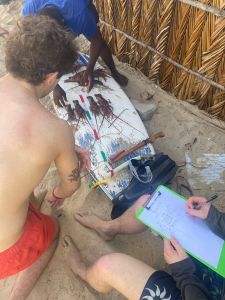
Tuesday came with our first early start to go to the fisheries at Guinjata and Paindane to collect data on fish caught by fishermen as part of LTO’s sustainable fisheries project. We then had a good bit of time to swim about, having our first chance to snorkel around close to the shore! Arriving back at the accommodation, we continued with lectures about community projects, such as their swimming lessons for children and adults, creating educational murals at schools in Guinjata and Paindane and educating women on sexual health and reproductive rights.
On Wednesday we visited the Guinjata fishing competition, which lasts a week and is taking out roughly 200kg of fish from the sea each day through game fishing, which is extremely destructive to the local ecosystem. We took pictures of the fish displayed at the competition and their weights and analysed them to work out measurements to be added to the sustainable fisheries data. Then, unfortunately, due to choppy waves in a constantly unpredictable weather system, we had to postpone snorkelling in the Coral Garden for Thursday and instead completed the last few lectures that we needed to do for our theory training to be complete!!
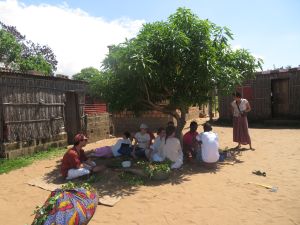
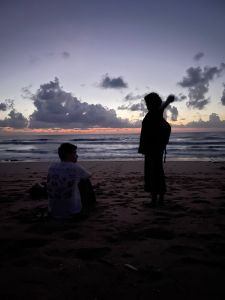
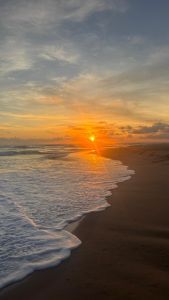
The earliest wake-up of the week came on Thursday morning, for which we had to wake up for 4:00am to go on a turtle walk on the beach with Joana, who is an expert at identifying turtles, their tracks and nests. While we weren’t fortunate enough to find any turtles, we did get to see a sunrise that I am confident none of us will be forgetting anytime soon!!! Then, after a quick break back at the accommodation, we headed into the village as part of a culture tour led by Pascoal, LTO’s Community Outreach Manager, to go and visit Guinjata school, at which the walls both outside and inside the classrooms were covered in murals that had been painted with the help of LTO. Only some of the classrooms had roofs due to a catastrophic cyclone that ripped the others off. The schools themselves can’t afford to replace them, LTO is doing what they can to get the funding to help the school replace it. Next stop was Pascoal’s house where we met his wife and children. We helped picking peanuts in the fields and then baked some delicious fiosas with Pascoal’s wife, Cristina. After a lovely snack in the shade with Pascoal and Cristina, we headed to Paindane school to have a quick look around before heading back to Blue Moon for our lunch. Next on the agenda was what we had all been waiting for – snorkelling in the Coral Gardens. Heading out on paddleboards and then dropping into the water, we laid out 25m transects along the reef at different points to count different cryptobenthic species, count all species in quadrats at 2.5m intervals and take videos with GoPro’s along the transect to identify different fish species that swam in front of the camera. This was so much fun and for some of us who had never been snorkelling or seen a reef in person before, was a life-changing experience that will never be forgotten.
Today, we woke up ready and raring to go to Jay’s Dive shop to get kitted up and head out on the sea for some long-awaited SCUBA diving!!! Once all the gear was gathered and loaded onto the boat, we pushed the boat out and were ready to head out to the first dive-site of the morning, Batfish. Joana, Francesca and Mario (one of LTO’s Field Officers) were our guides for the first dive and this was purely a fun dive to get us acquainted with the area and used to diving for those that hadn’t done so in a while. Mario, Joana and two of us even got lucky enough to spot a Blue Marlin on this dive! The second dive moved location to Devils Peak (which wasn’t quite as threatening as the name sounds) for us to carry out some transect work. This site was deeper than Batfish, but still with clear water allowing visibility of roughly 10m. Upon finishing the second dive and resurfacing, we headed to Jays Dive bar for a quick snack before finishing off the day with some quick species ID’ing from the data collected on the dive.
The experience we’ve had over the past week has been really unique and unforgettable, helped to be so by the amazing LTO team. Following on from all our work this week, I cannot wait to find out what the next week holds for us…